
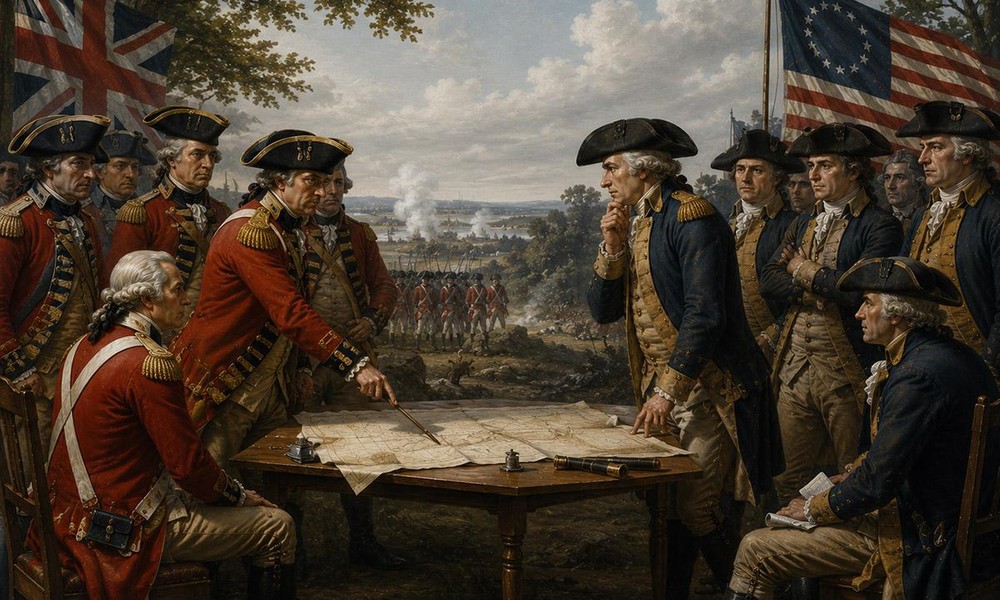
How different military tactics, leadership decisions, and battlefield goals shaped the outcome of the American Revolution.
When people think about the American Revolution, they often picture dramatic battles, soldiers in formation, and famous victories. However, winning a war requires far more than bravery alone. Behind every battle during the American Revolution, carefully planned military strategies, logistical decisions, leadership styles, and political goals influenced how each side fought. Although Britain possessed one of the strongest militaries in the world, the American colonies ultimately secured independence through persistence, adaptability, and strategic thinking.
The British Army entered the war with clear advantages. Britain had professional soldiers, a powerful navy, financial resources, global military experience, and access to trained officers. By comparison, the colonies lacked a standing army, struggled with supplies, and relied heavily on volunteers and militia forces.
Yet despite these disadvantages, colonial forces succeeded. One major reason was the contrast between British and American military strategies. Each side fought with different strengths, limitations, and objectives, and these differences shaped the course of the Revolution.
Understanding how British and colonial military strategies compared helps explain why one of the most powerful empires in history failed to defeat a much smaller opponent.
“The American Revolution was not simply won on the battlefield; it was won through strategy, endurance, and adaptation.”
Britain’s Military Strategy: Strength Through Conventional Warfare
Britain approached the Revolutionary War as a traditional military conflict. Having fought major wars across Europe and around the world, British leaders relied heavily on conventional military tactics that had proven successful in earlier conflicts.
British forces focused on direct engagements using disciplined formations, coordinated troop movements, artillery support, and organized battlefield control. Soldiers were professionally trained and expected to fight in organized lines, allowing commanders to maximize firepower and maintain discipline.
One of Britain’s biggest advantages was the powerful British Navy. Control of the seas allowed British troops to move efficiently along the coast, transport supplies, and maintain connections with Britain itself.
British leaders also believed they could isolate the rebellion geographically. Their strategy often focused on capturing major cities and controlling population centers to weaken colonial resistance.
Cities such as New York, Philadelphia, and Charleston became key military targets because British commanders assumed capturing political and economic centers would force the colonies to surrender.
Another important British assumption was that large numbers of colonists remained loyal to the Crown. British officials expected loyalist support to strengthen military operations and reduce colonial resistance.
However, many of these assumptions proved more complicated than anticipated.
Colonial Military Strategy: Survival and Adaptation
Unlike Britain, the colonies understood they did not need to completely destroy the British military to win the war. Instead, colonial leaders recognized that survival itself could eventually lead to victory.
Under the leadership of George Washington, the Continental Army often avoided unnecessary confrontations against larger British forces. Washington understood that preserving the army mattered more than winning every battle.
Rather than risking total destruction in one major engagement, colonial forces frequently retreated, regrouped, and fought selectively.
This strategy frustrated British commanders, who expected decisive victories to end the conflict quickly.
Militia forces also played an important role. Unlike professional soldiers, militias consisted of ordinary citizens who could fight locally, gather intelligence, disrupt supply lines, and use familiarity with local geography to their advantage.
Colonial troops often relied on mobility and flexibility instead of strict battlefield formations.
While Hollywood portrayals sometimes exaggerate guerrilla warfare during the Revolution, irregular tactics still played a meaningful role in certain regions. Hit-and-run attacks, ambushes, and surprise engagements created additional challenges for British forces trying to maintain control over vast territories.
Colonial leaders also understood the political side of warfare. Maintaining public morale and sustaining support for independence remained essential throughout the long conflict.
Geography Played a Major Role
One of Britain’s biggest challenges involved geography.
The colonies covered a massive area stretching across thousands of miles, filled with forests, rivers, mountains, farms, and unfamiliar terrain. Fighting across such a large region created enormous logistical difficulties for British commanders.
Even when British troops won battles or occupied cities, maintaining long-term control proved difficult.
Colonial forces could often retreat into rural areas, reorganize, and continue fighting elsewhere.
Long supply lines became another major issue for Britain. Supplies, reinforcements, and communication all required crossing the Atlantic Ocean, creating delays and vulnerabilities.
Meanwhile, colonial forces often relied on local knowledge and shorter supply networks.
In many ways, geography itself became an advantage for the colonies.
British commanders repeatedly underestimated how difficult it would be to control such a large and resistant population.
“Britain often won battles, but the colonies increasingly won the war of endurance.”
Leadership and Decision-Making Differences
Leadership also shaped military strategy significantly during the Revolution.
George Washington’s leadership style focused heavily on patience and long-term survival. Although criticized at times for retreats or battlefield losses, Washington understood the broader strategy: keep the Continental Army alive.
His ability to maintain morale during difficult winters, shortages, and defeats helped sustain the revolution during its darkest moments.
The winter at Valley Forge illustrates this leadership well. Despite extreme hardship, Washington preserved the army and strengthened discipline with the help of military training reforms.
British leadership, meanwhile, sometimes suffered from coordination problems and political interference.
Commanders occasionally disagreed about priorities, and military communication across the Atlantic remained slow.
One major example occurred during the Saratoga campaign in 1777, when British coordination failures contributed to a major colonial victory.
The colonial success at Saratoga later convinced France to formally support the American cause, dramatically changing the course of the war.
Leadership decisions therefore influenced outcomes far beyond individual battles.
The Southern Strategy and Britain’s Final Gamble
As the war progressed, Britain shifted tactics.
Believing loyalist support remained strongest in the South, British commanders adopted what became known as the Southern Strategy. The goal was to regain control of southern colonies, recruit loyalist support, and then move northward.
Initially, Britain achieved several successes in places like Georgia and South Carolina.
Eventually, however, the strategy encountered significant challenges.
Local resistance remained stronger than expected, supply problems continued, and colonial forces adapted effectively.
Leaders such as Nathanael Greene used strategic retreats and selective battles to weaken British forces over time.
The war eventually culminated at the Siege of Yorktown in 1781, where combined American and French forces trapped British General Cornwallis.
The surrender at Yorktown effectively ended major fighting and convinced Britain that continuing the war would be too costly.
Why Colonial Strategy Ultimately Succeeded
The colonies succeeded not because they were militarily superior in every category, but because their strategy aligned more closely with their goals.
Britain needed decisive victory and control. The colonies simply needed to continue resisting long enough to make the war politically and financially unsustainable for Britain.
Colonial adaptability became a major strength.
Washington’s emphasis on survival, local militia support, knowledge of terrain, foreign alliances, and strategic patience all contributed to eventual success.
France’s alliance also proved essential by adding naval strength, military supplies, and international pressure against Britain.
Ultimately, Britain struggled to defeat an opponent unwilling to fight on Britain’s preferred terms.
FAQs
What military advantage did Britain have?
Britain had professional soldiers, a strong navy, financial resources, and experienced military leadership.
Why didn’t the colonies fight traditionally?
Colonial leaders knew direct battles against Britain carried high risks, so survival and selective fighting became more important.
What role did George Washington play?
Washington focused on preserving the Continental Army and avoiding total defeat, helping sustain the revolution long term.
Why was Yorktown important?
The British surrender at Yorktown effectively ended major military fighting and secured American independence.
Conclusion
The American Revolution was shaped as much by strategy as by courage. Britain entered the war with overwhelming advantages, but colonial leaders adapted their methods to match reality. While British commanders pursued traditional victories and territorial control, colonial forces focused on endurance, flexibility, and long-term resistance.
Geography, leadership, foreign alliances, and strategic patience all helped shift momentum toward the colonies. In the end, the Revolution demonstrated that military strength alone does not guarantee victory. Sometimes success belongs to the side that better understands its goals, limitations, and opportunities.
