
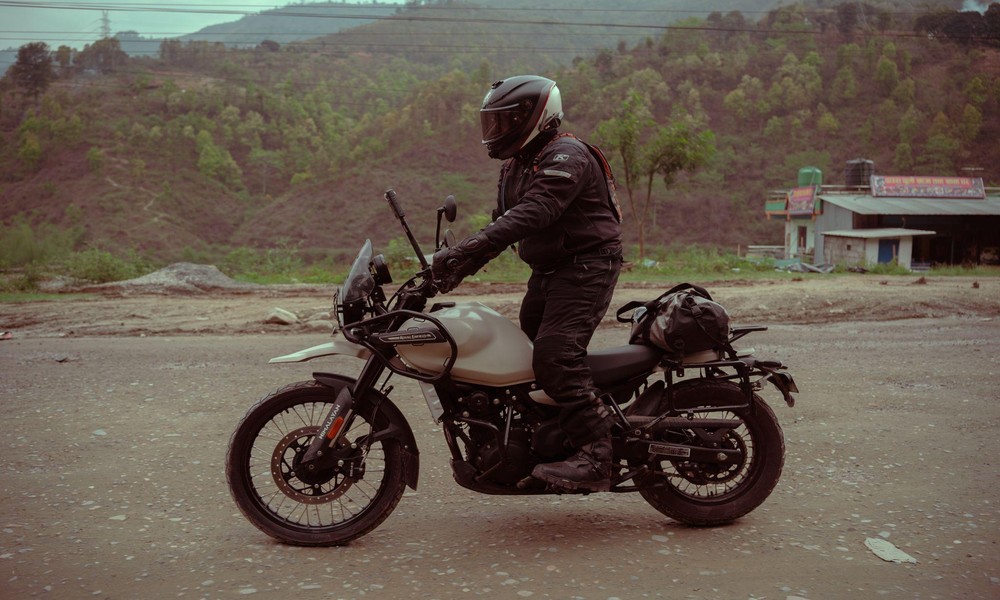
Print out any adventure motorcycle gear list from a popular riding blog and it will look broadly correct. Helmet, jacket, gloves, boots, base layers, rain gear, toolkit, first aid kit. If you are preparing for a tour through Europe, parts of Central Asia, or even the more developed Himalayan routes on the Indian side, that list will serve you reasonably well.
Bring it to Nepal without modification and it will quietly fail you, not dramatically, not all at once, but in the accumulated ways that turn a challenging expedition into a miserable one. The wrong gloves on the Thorong La. Waterproofing that works in Scottish rain but not in a Monsoon-adjacent downpour above Tatopani. Boots that handle gravel tracks but turn into anchors crossing the Kali Gandaki riverbed. A toolkit assembled for roadside repairs on routes where roadside repair shops exist.
Nepal’s mountain riding environment is specific enough that it deserves its own gear logic. This article gives you that logic, section by section.
Why Generic Adventure Gear Lists Fail Nepal’s Conditions
The standard adventure motorcycle gear list is built around a composite rider: someone doing multi-day touring on mixed surfaces, in temperate or semi-arid climates, with access to towns and services at reasonable intervals. That composite rider and their gear assumptions diverge from Nepal’s reality in four fundamental ways.
First, the temperature range Nepal demands within a single riding day is extreme. Leaving Besi Sahar in the Marsyangdi valley at 820 metres, the morning temperature might be 28°C and humid. Arriving at Manang at 3,500 metres six hours later, it drops to 8°C with wind. Riders who gear for either condition exclusively spend half their day dangerously uncomfortable or dangerously overheated.
Second, Nepal’s wet season which overlaps significantly with the primary riding window – produces precipitation that bears no resemblance to European rain. Monsoon rainfall in the Himalayan foothills is sustained, heavy, warm, and capable of soaking through “waterproof” membranes that perform perfectly in drizzle because those membranes were never tested under real volume.
Third, river crossings are not optional on most serious Nepal routes. They are routine. This changes the calculus for boots, lower-body protection, luggage waterproofing, and electronics protection entirely.
Fourth, the combination of dust, altitude, UV intensity, and physical exertion on Nepal’s routes accelerates gear degradation at a rate that catches riders accustomed to more forgiving environments off guard. Gear that would last a European summer season may reach end-of-life on a three-week Nepal circuit.
Helmet: Reconsider Your Ventilation Logic
Most adventure riders on motorcycle tours to Nepal bring a full-face helmet with generous ventilation, correct for warm-weather riding in Europe or Southeast Asia. Nepal’s specific combination of altitude, cold, dust, and temperature variation argues for a different priority order.
At elevations above 3,500 metres, heavily vented helmets accelerate heat loss from the head in ways that contribute meaningfully to fatigue and, at the severe end, hypothermia risk. The ideal Nepal helmet is a dual-sport or adventure full-face with a ventilation system that can be substantially closed, not merely reduced. Helmets where the vents are either fully open or partially open are a poor choice for high-altitude riding where you need genuine thermal control.
The second helmet consideration Nepal demands is a quality anti-fog visor or a pinlock insert that actually works. Temperature differentials between your breath, the visor, and the external air on high passes create fogging conditions that a basic visor cannot handle. Riders who have crossed Thorong La in the early morning, when temperature and humidity combine worst, almost uniformly describe visor fogging as a serious safety issue if the helmet is not prepared for it.
Dust is the third factor. The dry season routes, Mustang, Dolpo, the rain shadow areas north of the Annapurna and Dhaulagiri ranges generate fine particulate dust at a volume and consistency that standard adventure riding does not prepare you for. A helmet with good facial sealing around the lower chin section dramatically reduces the amount of dust reaching your airway during a long day in the Upper Mustang motorbike tour. This is not comfort. After eight hours of sustained dust exposure, it is a respiratory health consideration.
Jacket: Layering Beats Single-Piece Solutions
The single most common jacket mistake Nepal-bound riders make is bringing a single high-specification jacket and treating it as an all-conditions solution. A premium textile adventure jacket with a removable liner and waterproof membrane sounds like exactly the right tool. In practice, Nepal’s temperature range defeats it.
The liner that keeps you warm at 3,500 metres makes you dangerously overheated at 800 metres on the same day. The waterproof membrane that handles European rain saturates under sustained Monsoon-weight precipitation. And most critically, removing or adding the liner on a Nepal mountain road requires either a full stop and a ten-minute faff, or accepting that you will be wrong-temperature for extended periods.
The gear logic that works better for Nepal is layering with a lighter base shell:
A mesh or highly vented motorcycle jacket as your base layer, worn in the valleys and lower elevations. Over this, a quality mid-layer fleece, not a proprietary motorcycle liner but a standalone fleece you can add or remove in two minutes at a roadside stop. Over everything, a separate packable rain jacket with real waterproofing, stored accessible in your top bag, deployed when precipitation actually begins rather than worn prophylactically and sweated through.
While talking about the packing list for motorcycle touring in Nepal, This three-piece approach adds slightly to pack volume but gives you genuine temperature control across Nepal’s elevation range without the compromises of any single jacket trying to do all three jobs at once.
The Waterproofing Standard Nepal Actually Requires
If your rain jacket is not rated to at least 20,000mm hydrostatic head, it is not adequate for Nepal’s Monsoon-adjacent conditions. Most mid-range adventure jackets carry waterproof ratings of 5,000-10,000mm, sufficient for European weather, inadequate for sustained heavy Himalayan precipitation. Budget accordingly. A separate, purpose-built hard-shell rain jacket from an outdoor brand rated at 20,000mm or above will outperform a 10,000mm integrated motorcycle jacket in Nepal’s conditions every time.
Gloves: You Need Three Pairs, Not One
Standard adventure gear lists suggest one pair of riding gloves, perhaps with a waterproof option. Nepal requires three distinct pairs used for distinct conditions, and treating this as an extravagance rather than a necessity is how riders end up with frostbitten fingers on high passes or hands too sweaty to grip properly in the valleys.
Pair one – lightweight summer gloves for valley riding below 2,500 metres where temperatures are warm and dexterity matters more than insulation. Thin, touchscreen-compatible, quick-drying. These are your daily gloves for the lower elevation sections.
Pair two – mid-weight waterproof gloves for mixed conditions between 2,500 and 4,000 metres. Waterproof membrane, moderate insulation, still dexterous enough for operating camera controls and bike instruments. This is the glove you reach for most frequently on a Himalayan circuit.
Pair three – heavyweight winter or ski gloves for pass crossings above 4,500 metres. Not motorcycle-specific gloves with nominal insulation. Actual winter gloves rated to -10°C or below. Thorong La, Larke Pass, the crossings above Muktinath – these elevations combined with wind chill produce conditions that defeat anything less. The inability to operate brake and clutch levers with confidence because your hands are seized with cold is not a discomfort problem. It is a safety problem.
Pack all three. The combined volume is manageable. The alternative – one compromised pair doing all three jobs poorly – is not acceptable on Nepal’s terrain.
Boots: Waterproofing Is Secondary to Crossing Ability
Most adventure motorcycle boots are designed with waterproofing as a primary feature – a Gore-Tex membrane or equivalent that keeps feet dry in rain and wet roads. In Nepal, this design priority creates a specific problem: when you submerge a waterproof boot in a river crossing, water enters over the top of the boot and becomes trapped inside by the same membrane that keeps external water out. You then ride with boots that are soaked internally for the rest of the day, which is considerably more unpleasant than boots that wet through quickly but also drain and dry quickly.
The better Nepal boot solution is an adventure or dual-sport boot with strong ankle protection and sole grip but without a sealed waterproof membrane – paired with neoprene socks for river crossing sections. The neoprene sock keeps feet warm and reduces the impact of water immersion. The non-waterproof boot drains and begins drying within an hour of the crossing. This combination outperforms a premium waterproof adventure boot on Nepal’s specific river crossing conditions in almost every practical test.
Boot sole grip on loose rock and river cobbles is the second critical specification. Vibram-style lug soles or equivalent perform significantly better than the flatter, firmer soles common on road-biased adventure boots when you are putting a foot down on a wet river crossing or manhandling the bike across a loose section on foot.
Base Layers: Merino Wool Over Synthetic, Without Debate
This one is settled. Merino wool base layers outperform synthetic alternatives in Nepal’s conditions for three reasons that compound across a multi-day expedition.
Merino regulates temperature across a wider range than synthetics, handles the valley-to-pass temperature differential better, and – most importantly for multi-day riders with limited laundry access – does not accumulate odour at the rate synthetic fabrics do. A merino base layer worn for three consecutive days remains tolerable. A synthetic equivalent does not. On a two-week Nepal circuit where laundry facilities range from basic to nonexistent, this is a quality-of-life consideration that affects daily comfort meaningfully.
Bring two merino tops and one merino base layer bottom. This is sufficient for rotation on most Nepal expedition lengths without excess pack weight.
Luggage: Hard Cases Lose, Dry Bags Win
Aluminium panniers – the aesthetic standard of the serious adventure motorcycle – are genuinely excellent in the environments they were designed for. On Nepal’s mountain roads, they carry specific disadvantages that most gear lists never address.
Hard cases are rigid. Nepal’s trails include sections where the track narrows to a width that requires careful judgment about pannier clearance against rock walls, passing vehicles, and trail edges. Aluminium cases that get knocked repeatedly against rock faces dent, warp, and eventually fail their seals – at which point their waterproofing advantage over soft luggage largely disappears. They are also significantly heavier, raising the centre of gravity on a bike that you will be manhandling through river crossings regularly.
The luggage system that works better for Nepal combines a tail bag or dry bag on the rear rack for the majority of your kit, with smaller soft bags on either side if side volume is needed. Ortlieb dry bags, Sea to Summit compression dry bags, or equivalent purpose-built waterproof soft luggage offer genuine waterproofing, flexibility around narrow trail sections, significantly lower weight, and the ability to detach and carry your luggage separately when pushing or recovering the bike.
Electronics and Documents: Waterproofing Is Not Optional
Every electronic item and every document that matters should travel in a dedicated waterproof case or dry bag within your luggage, regardless of your outer luggage waterproofing claims. GPS units, phones, cameras, battery banks, and permit documents that get wet in Nepal’s conditions get wet seriously and often without warning. A small Pelican case or equivalent for electronics, and a zip-lock system for documents, adds negligible weight and eliminates a category of loss that has ended Nepal expeditions early.
The Toolkit: Build It for Nepal’s Repair Reality
A standard adventure motorcycle toolkit covers the repairs you can make at a roadside stop with basic mechanical competence. Nepal’s repair reality extends this requirement considerably, because the gap between where a problem occurs and where a repair shop exists is frequently measured in days rather than hours.
Your Nepal toolkit needs to add to the standard base:
A comprehensive tyre repair kit – not a single plug kit but a full puncture repair system with multiple plugs, patch material, and a hand pump or CO2 inflation system adequate for a 21-inch front tyre. Tyre punctures on Nepal’s rocky tracks are not occasional. They are routine, and being able to complete a full repair independently rather than a temporary fix is the difference between continuing your ride and walking out.
Spare clutch and brake levers, cable ends, and throttle cable. Falls on Nepal’s terrain are not exceptional – they happen to experienced riders on technical sections, river crossings, and soft ground. A snapped brake or clutch lever is a ride-ending event unless you carry a replacement. The levers weigh almost nothing and take almost no space.
A quality multimeter for electrical fault diagnosis. Nepal’s roads vibrate connections loose. A multimeter that lets you trace an electrical fault quickly – rather than arriving at a tea house with a dead bike and no diagnostic capability – is worth its weight substantially.
Zip ties, self-amalgamating tape, and JB Weld or equivalent epoxy. Nepal’s repair culture is inventive and practical, and local mechanics will work with whatever materials you have available. These three items have saved more Nepal expeditions than any specialised tool.
What to Leave Behind
The gear that adds weight and pack volume without earning it on Nepal’s routes:
Dedicated highway pegs and comfort additions optimised for motorway cruising. There are no motorways. Heated grip systems that depend on reliable electrical systems to function – the weight-to-reliability ratio is poor in this environment. A full wardrobe of casual clothing beyond the functional minimum – towns with restaurants and social scenes exist along Nepal’s circuits, but the riding days between them are long enough that the weight cost of excess clothing is not recovered by the comfort. And any piece of gear whose maintenance or repair requires a specialist – the environment selects hard against complexity.
The Governing Principle for Nepal Gear Selection
Every piece of gear you bring to Nepal should be evaluated against a single question: does this work when it is wet, cold, altitude-stressed, and two days from the nearest town with any repair capability?
The gear that passes that test is usually simpler, tougher, more repairable, and less electronically dependent than the gear that fails it. Nepal does not reward sophistication. It rewards resilience, repairability, and the specific preparation that comes from understanding that its mountain roads are not merely difficult versions of roads you have ridden before. They are their own category entirely – and they deserve gear chosen on their own terms.
